
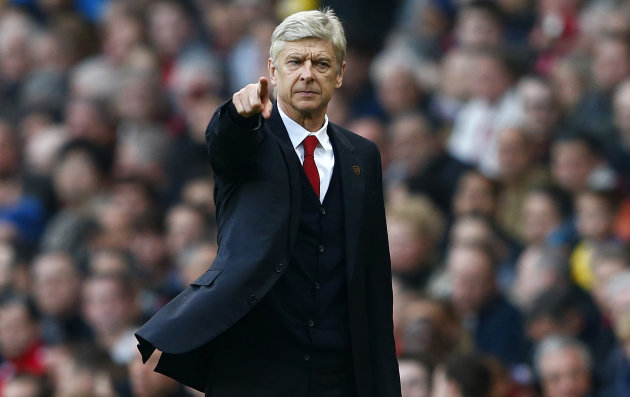
It is not quite the same as Manchester City against Tottenham in 2010, which was scheduled right at the end of the season. But Sunday’s Fourth Place Cup Final between Everton and Arsenal is nonetheless an occasion full of significance, full of interest, full of possibility.
It marks the coming together of a manager on the up and a manager
whose upward trajectory long ago stalled, between a club stretching
beyond its financial means and one serially under-achieving, between a
team relying heavily on other clubs’ employees and one capable of buying
at the very top. In short, between a club who are way ahead of
expectation and one who continue to frustrate with their inability to
match potential to silverware.
In many ways it is surprising that it has come to this. Less than a month ago Arsenal hammered Everton
4-1 in the FA Cup quarter final. On that occasion, there was no thought
the two might be coming together this weekend on almost equal terms.
But Everton have put together a run of five consecutive league victories
and are suddenly breathing down the neck of Arsenal, who are
experiencing their standard late-season stall.
Four points behind with a game in hand – and that a home encounter with Crystal Palace
– win on Sunday and suddenly fourth place, and with it the
money-printing exercise that is Champions League qualification, looks a
prospect for Everton. There is still a way to go, but two teams from
Merseyside in Europe: it would be like the 1980s all over again.
For some, Sunday’s narrative centres on the two managers. In the blue corner is Roberto Martinez,
the Premier League’s most innovative, exciting young coach and proof
positive that despite all available evidence it is possible to be a nice
guy in this business and thrive. Intelligent, positive, invariably
patient and polite, by all accounts Martinez is a joy to work for.
Players respond to his mix of upbeat enthusiasm and canny tactical
acumen. He makes the right decisions and he makes them quickly.
He has taken a team renowned for its stubborn refusal to yield and
turned them into a smart, clever, adventurous outfit. He has brought on
the young players he inherited – Ross Barkley, Seamus Coleman,
John Stones – to a level his predecessor was not convinced they could
reach. His ventures into the transfer market – whether permanent or on
loan – have been masterful. Indeed, the borrowing of Gareth Barry, Gerard Deulofeu and Romelu Lukaku have turned out to be the coups of the season.
If all this sounds rather familiar – the transformation of a stubborn
club into a free-flowing glory bunch, the mix of tactical nous and
progressive man management, the ability to seek out value in the market –
it is because they used to be traits readily associated with his
opposite number on Sunday. But it has been a long time since Arsene
Wenger was the next big thing.
A survey of Arsenal fans taken this week suggested that 50 per cent
of them believe if neither the FA Cup was won nor Champions League
qualification secured then it would be better for all if Wenger quit at
the end of the season. While online polls are not the most rigorous of
statistical analysis, that speaks of the widespread adherence in the
Emirates stands to the idea that it may be time to thank the grand old
man for his efforts over the past 18 seasons and move on. The truth is,
the frustrations in the continuing failure to convert financial
stability into success will only disappear with a trophy.
Those who write off Wenger as an anachronism, however, should be
warned: this is a manager whose ability to confound expectation is
legend. There was a hint in last Sunday’s comeback against Manchester City
that he might yet reverse the decline that has seen his team slip from
championship contenders at Christmas to fighting for fourth in the
spring.
Given that he has lost Jack Wilshere, Mesut Ozil, Theo Walcott
and Aaron Ramsey to long-term injury since his gilded autumn, mind,
even to be in contention might be considered an achievement. Fitness
reports suggest, however, that Wenger will be able to recall Ramsey at
Goodison, which would be a huge positive for the remaining programme.
Especially as, after Everton, Arsenal have a run-in involving West Ham,
Hull, Newcastle, West Brom and Norwich. Given that Everton have to face Southampton, Manchester United and Manchester City in their run-in, even defeat at Goodison may not be wholly disastrous for Wenger.
Indeed, for the Arsenal boss the more important date is surely not
this coming Sunday but next weekend, when he takes his team to Wembley
for an FA Cup semi-final. With all due respect to Wigan – which is
football speak for offering no respect at all - faced with the
opposition left in the competition, if he doesn’t land the FA Cup Wenger
really ought to consider packing it all in. The endless talk of
character and potential would sound awfully hollow if he failed to
by-pass Uwe Rosler’s livewire operation and then one of either Hull or Sheffield United.
Next Sunday’s fixture is the one he has to get right. After that, he
can turn his attention to securing fourth place and maintaining his
long-standing tradition of qualifying for the Champions League. If he
does both, the growling in the stands will surely abate. And, while even
a man as nice as Roberto Martinez might not join in the applause, were he to do so it would be a fitting marker of Wenger’s continuing relevance.
